

Openknowledgemaps


What is Open Knowledge Maps?
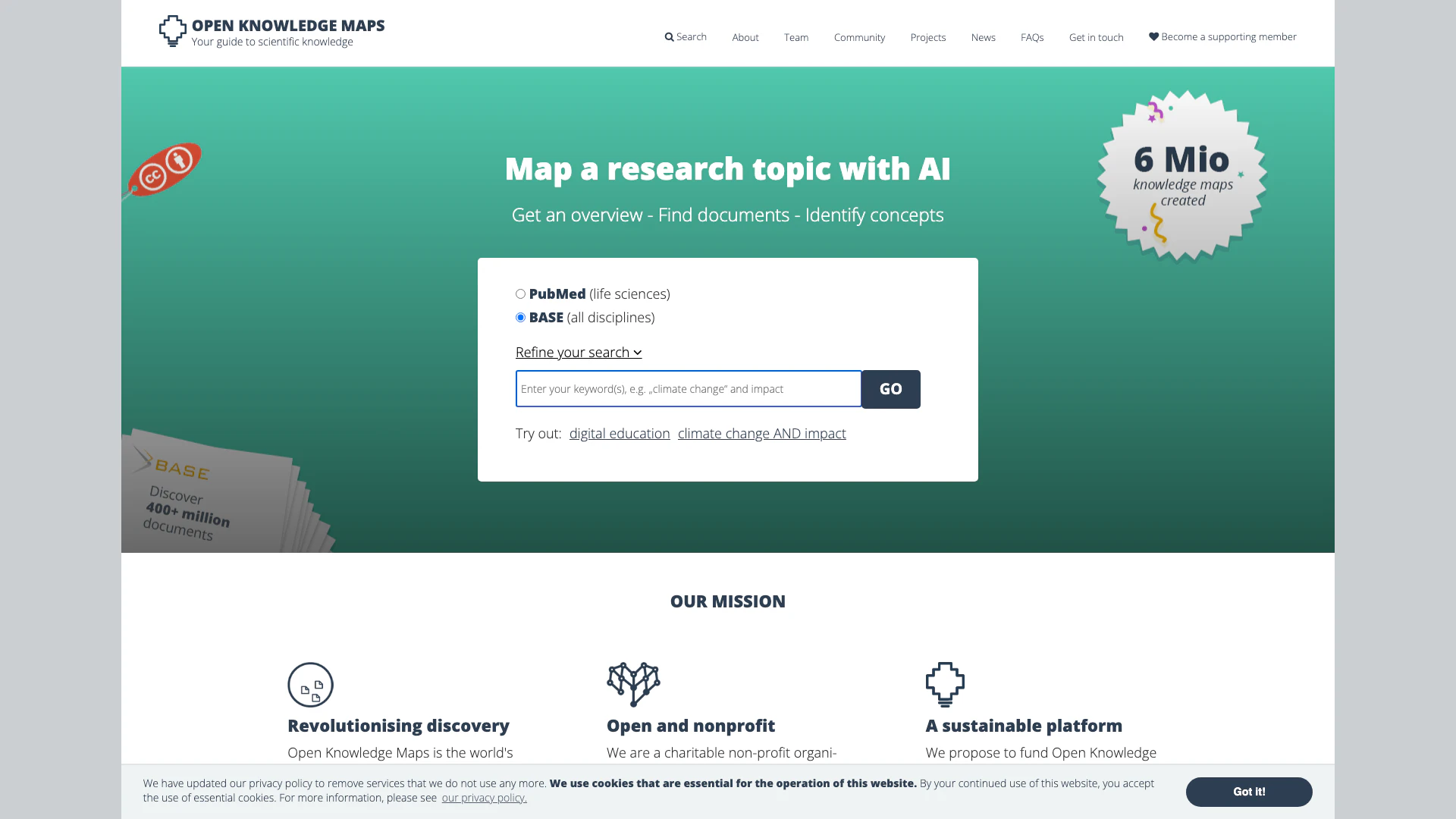
Open Knowledge Maps is an innovative AI-based search engine[2] designed to enhance the visibility of scientific knowledge. It provides users with a visual overview of research topics[4], enabling them to discover relevant papers and identify key concepts within their field of interest. As the world's largest platform of its kind, Open Knowledge Maps aims to revolutionize the way individuals engage with scientific literature[3], making research more accessible and comprehensible for both academia and society.
How to use Open Knowledge Maps?
- Visit the Open Knowledge Maps website at [openknowledgemaps.org](https://openknowledgemaps.org/index).
- Use the search bar to enter your research topic or keywords.
- Refine your search results by selecting document types and metadata quality preferences.
- Browse the visual map generated, which clusters relevant papers and highlights important concepts.
- Click on any paper to access its details, including abstracts and links to the full text.
What are the main features of Open Knowledge Maps?
- Visual Mapping[1]: Generates a visual representation of research topics, allowing users to see connections between papers and concepts.
- Comprehensive Search[5]: Access a wide range of document types including articles, theses, and reports from various disciplines.
- Refinement Options: Users can filter results by document type and metadata quality to find the most relevant literature.
- Open Science Commitment: Operates as a non-profit organization promoting open access to scientific knowledge.
Who is Open Knowledge Maps for?
Open Knowledge Maps is designed for researchers, students, and academics who seek to enhance their literature review process. It is particularly beneficial for those in the fields of science and academia who require efficient access to a wide array of scientific papers and concepts. Additionally, educators and institutions interested in promoting open science and improving knowledge accessibility can leverage this tool for their educational initiatives.
What are the use cases of Open Knowledge Maps?
- Literature Reviews: Researchers can use Open Knowledge Maps to gather and visualize relevant literature on a specific topic, making it easier to identify key studies and gaps in research.
- Academic Teaching: Educators can incorporate Open Knowledge Maps into their curriculum to teach students about literature search techniques and the importance of visualizing information.
- Collaborative Research: Teams can utilize the platform to collectively explore and discuss relevant research papers, fostering collaboration and enhancing understanding of complex topics.
Openknowledgemaps Pros and Cons
Pros
- Visual Overview of Research Topics: Open Knowledge Maps provides a visual representation of research topics, helping users to easily understand the relationships between different concepts and papers.
- AI-Based Search Engine: As the world's largest AI-based search engine for scientific knowledge, it enhances the visibility of research findings for both science and society.
- Open and Nonprofit Organization: Being a charitable nonprofit organization, Open Knowledge Maps promotes open science principles, making it accessible to everyone.
Cons
No cons data detected for this tool
Analytics of Openknowledgemaps
Openknowledgemaps Website Traffic Analysis
Visits Over Time
Traffic Sources
Nov 2025 - Jan 2026 Worldwide Desktop Only
- Search: 56.99%
- Direct: 33.42%
- Referrals: 7.12%
- Social: 1.73%
- Paid Referrals: 0.50%
- Mail: 0.11%
Top Keywords
| Keyword | Volume | CPC | Estimated Value |
|---|---|---|---|
| maps | 45.66M | $0.37 | $2100.00 |
| gmaps | 1.02M | $2.54 | $240.00 |
| open knowledge maps | 3.83K | $0.30 | $3560.00 |
| open knowledge | 720 | $0.79 | $170.00 |
| knowledge maps | 430 | $0.00 | $390.00 |
Openknowledgemaps Reviews
We joined Open Knowledge Maps as a Supporting Member because it is an innovative tool for literature search and we are eager to support the further development of Open Knowledge Maps. Dr. David Johann, Head of Group Knowledge Management, ETH Library, ETH Zurich
I love how OKMaps breaks down the papers into clusters allowing me to identify themes in the literature and focus on papers that are most pertinent for my work. Girija Goyal, ReFigure Co-Founder, Staff Scientist at Wyss Institute for Biologically Inspired Engineering at Harvard University, USA
Open Knowledge Maps is a considerable reinforcement in the areas of open science & open access, which are central to our research services. Dr. Andrea Hacker, Open Access and Bern Open Publishing (BOP), University Library Bern
For more reviews, visit this link: https://openknowledgemaps.org/#what-users-and-supporters-say


Openknowledgemaps Social Listening
TEMUKAN IDE DAN NOVELTY PENELI...
Menggunakan Platform Open Know...
Pada video ini, saya berbagi p...
1. Open Knowledge Maps: An AI ...
Email: dhavalmaheta1977@gmail....
Unlock to view 32 social media results.